
R10 T15 perforated sheet metal for ventilation
Definition R10T15
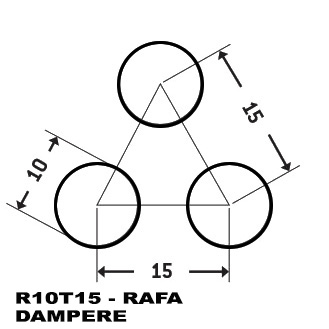
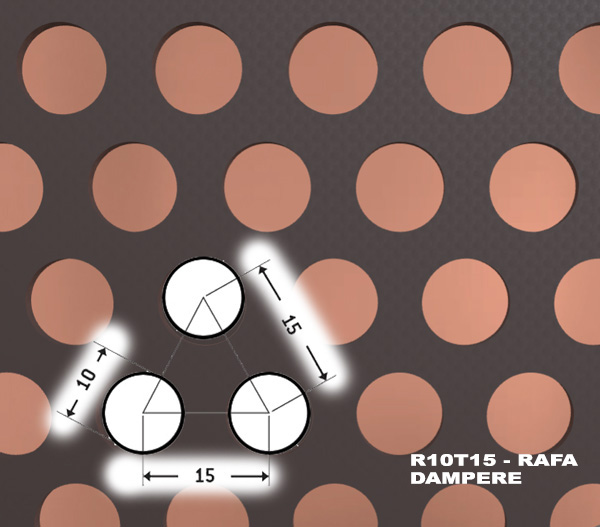
The technical definition of an R10T15 perforated sheet is based on the characteristics set out in the perforation guide. A standard round perforation with a staggered and regular arrangement of 10 mm diameter holes. The regularity of the holes applies to two aspects: firstly, the identical R10 holes (10 mm round) across the entire surface of the sheet metal, and secondly, the triangular arrangement with a 15 mm center-to-center distance between the holes, as shown in the attached diagram, which complies with the DIN 24041 perforation standard. This standard hole distribution according to the "T" mode complies with the hole placement standard to form an isosceles triangle with equal 60° angles. This morphology generates an equilateral triangle of holes with a diameter of 10 millimeters on either side, in an infinite repetition. By multiplying the holes on the mechanical punching machine, we obtain thousands of holes on the perforated plate at the end of the operation.
In all directions, there is a 5 mm gap between the holes to give the R10T15 perforated sheet metal rigidity and stiffness. This residual material gives the perforation its aesthetic appeal, allowing it to be used in both technical and decorative applications.
Use of R10T15 perforated sheet metal in ventilation systems
The standard R10T15 perforated sheet metal – RAFA ideal for ventilation applications as it has a 40% open area. This large opening allows air to pass freely with little pressure loss as it passes through the metal grille. Its large hole size makes it easier to shape, and the 5 mm solid space between the holes allows a self-tapping screw to be inserted anywhere in the center of the panel between two 10 mm R10 perforations. This arrangement makes it very easy to install R10 T15 perforated sheet metal on a metal frame or as machine protection.
The size of the hole requires the use of mosquito netting to reduce the passage of small insects, so this should be taken into account if the ventilation grille is located at the base of the building.
The ease of understanding of R10T15 perforated sheet metal and its easy installation make this perforation a regular choice for all ventilation applications, as presented in the rest of this document.
R10T15 perforated sheet metal fits anywhere
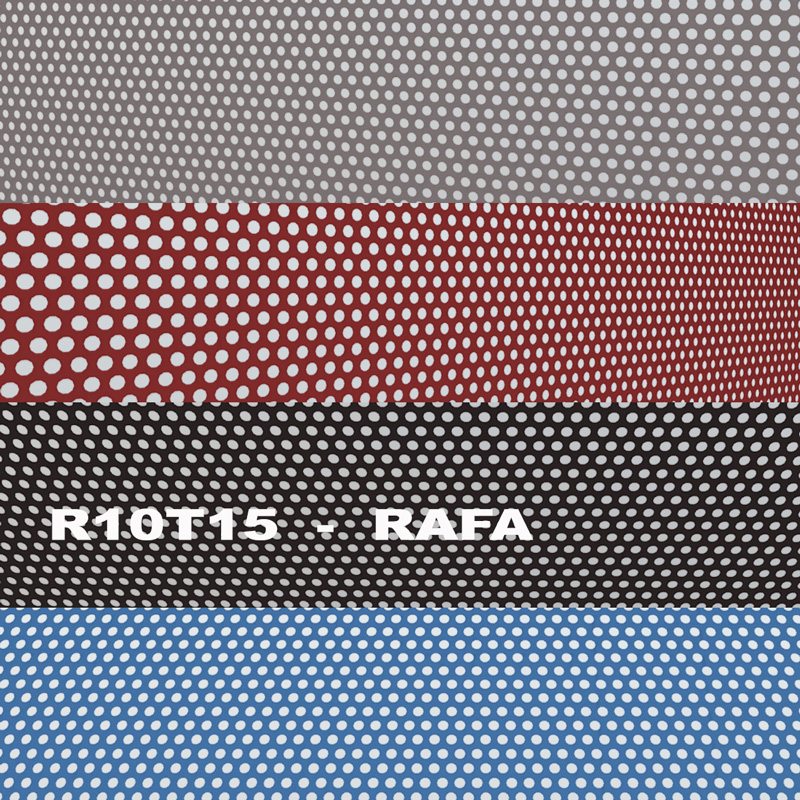
Available in RAL 3001 Fire Red for high visibility contrast, as well as RAL 1016 Sulfur Yellow, the R10 T15 ventilation perforation can also blend into the landscape with RAL 6018 Yellow Green or RAL 5005 Sky Blue. Standard colors such as RAL 9010, RAL 7016, RAL 7046, and RAL 9004 are obviously used in ventilation. The choice of color will depend on the location of the perforation. Often installed outside the building at the air extraction outlet, the R10 T15 grille will adapt to the color of the urban environment to remain within the scope of the local urban planning regulations, while blending in with or camouflaging the technical components.
The R10T15 metal plate is used everywhere, so commonly that we end up not noticing it around us anymore, because it is the most frequently used perforated sheet metal and can be found everywhere.
Industrial applications: In industrial functions within a commercial activity zone (ZAC), perforated sheet metal is used in various applications such as ventilation of facilities, creation of protective screens, and even as a decorative element within structures to conceal the presence of pipes, cables, and industrial production fixtures, thus preventing these elements from being visible to everyone.
Machine safety: In certain specific technical situations, R10 T15 perforated sheet metal can be used as a safety screen, acting as a visual barrier while allowing adequate ventilation. This use is particularly crucial in places such as train stations, subway stations, or airports, where large numbers of people may be present, in order to restrict access to technical facilities while maintaining good visibility.
Protection of equipment against intrusion and vandalism. Ventilation must be carried out safely, protecting against the risks associated with intrusion and theft, even under certain conditions. RAFA will resist fire.
Limits on the use of the R10T15 drill
The R10T15 drill bit is not suitable for all uses; it is versatile but not omnipotent. There have been no technical or aesthetic changes for nearly two centuries, as it is a raw, standardized product. Any change or adaptation would result in a different product that would no longer be the R10T15! The rigidity of the product is an industrial advantage but also a major disadvantage.
Here are the limits for everyday use of an R10T15 – RAFA perforated grid.
Standard perforated sheets are metal plates with regular perforations across the entire exposed surface. Certain limitations must be taken into account when using them or in specific applications.
R10T15 perforated sheet metal is not waterproof! Yes, it's almost a pleonasm, but we get asked this question so often that we prefer to write it down. In heavy rain with gusts of wind, water can easily pass through the perforated sheet.
The size of the round hole with a diameter of 10 mm involves a series of dimensional constraints. When using R10, several control points must be taken into account:
- Finger pinch hazard for children not guaranteed. The guideline for preventing finger pinch hazards is established for a maximum diameter of 8 mm. The R10 perforation therefore exceeds the diameter limit, potentially posing a risk of a child's finger becoming stuck in the hole with few solutions for removing it because the skin is caught in the pinch. In a public place where children are free to play, it is not advisable to use R10T15 perforated sheet metal as it poses unpleasant immobilization problems.
- Airflow in R10T15 is determined by the vacancy rate but also by the pressure drop at the outlet of the R10 grille. Thus, a hole in R15 with the same transparency rate allows air to pass through more easily because there is less pressure drop. It is advisable to check the airflow and pressure drop parameters at the grille outlet in order to make the right choice for ventilation.
Aesthetics are not the strong point of the R10T15 perforation. The advantage of the simplicity of standard perforation ultimately becomes a weakness. Seeing this perforated plate everywhere, the eye eventually tires of it. It's a balance that needs to be found. Do we want a simple, characterless perforation pattern? In that case, the ø10 – RAFA solution RAFA well. For a project with a decorative purpose and an architectural impact to mark the urban landscape, this is not the right product. It is better to opt for the decorative perforated sheet metal range.
It is essential to take these limitations into account when specifying and using ventilation panels, choosing materials and designs suited to the specific requirements of the intended application.
What finish for R10T15?
The R10 T15 metal pattern can be used anywhere: train station concourses, hotel rooms, underground parking lots. Natural ventilation and air management are part of construction specifications. Perforation is used as a decorative screen to hide the technical mechanism from view. Air treatment machines are not very attractive, but perforated sheet metal offers a more aesthetic finish. By working on the finishes of the R10T15, we achieve a more pleasing result.
Raw sheet metal format
R10T15 perforated sheet metal is available in standard sheet sizes of 2000×1000 – 2500×1250 – 3000×1500 mm, as well as all intermediate sizes such as 1200×800 and 1000×1000 mm, at a price of €60/m². Using the perforated sheet metal configurator, you can adapt and customize the format of the perforated sheet metal you want to use for ventilation. The economical free format allows the sheet metal to be cut directly at the factory to the right size, with custom cutting that respects the squareness of the sheet metal while maintaining solid edges for fastening.
Perforated plate borders
The edge of a perforated plate is not only used to attach the panel to its frame. First and foremost, it allows for safe handling, as a plate with sharp perforated edges remains very sharp. This is a very common cause of cuts in the workshop, especially on thin sheets. We recommend R10T15 perforated sheet metal with non-perforated edges on all four sides of the sheet, which makes it easy to grip, handle, install, and remove. The size of the edge can be adjusted directly on the perforation configurator according to your needs, with a minimum of 5 mm and a maximum of 50 mm of peripheral edge. The border acts as a seam, providing the finishing touch needed for a beautiful result.
RAL powder coating color of your choice
Perforated sheet metal becomes more attractive when a surface painter is used. Coloring with RAL shades gives the surface color and makes it more distinctive. The RAL color chart is very extensive, so it is possible to choose shades that match your design project. Shades of gray are most commonly used, but certain colors, particularly pastel shades, can bring the perforation to life.
Cassette folding R10T15
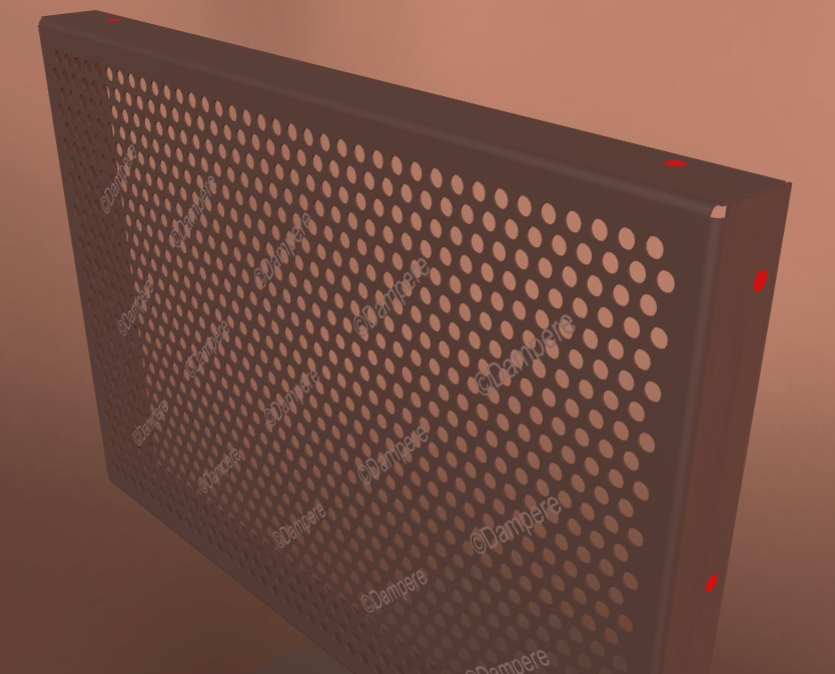
Cassette folding of R10 T15 perforated sheet metal adds value to the openwork metal plate. From a mechanical point of view, sheet metal folding provides rigidity by pulling on the neutral fiber of the sheet metal. Similar to the tension of a leather skin on a frame, lateral folding with 90° folded edges on a sheet metal panel will stretch the perforated metal, thus giving it more strength to resist the forces applied to the surface. In addition, you can add fixing holes in the folds of the cassette to create an invisible attachment. The screws and sheet metal supports are concealed by the fold.
How does R10T15 perforated sheet metal perform?
The natural ventilation and protection of structures provided by perforation allows it to be used anywhere. The performance of R10T15 perforation is evident in its ubiquity in industrial environments, street furniture, and housing protection. Its performance is effective at various levels:
- R10T15 ventilation grille with air porosity of around 40%, promoting efficient air exchange through this grille.
- R10T15 railing infill in RAL 7016 color for apartment building balcony
- R10T15 sunshade to reduce solar impact on the facade
- R10T15 machine guard for compliance and operator safety
- Perforated sheet metal bus shelters – RAFA prevent glass breakage due to vandalism
- R10T15 for cellars or basement windows to ensure natural ventilation
- HVAC and air conditioning unit cladding for an R10T15 fence in RAL 9010 white, providing economical privacy screening.
The first reference we discover in standard sheet metal or the first sheet metal sample will inevitably be this standard perforation. Number 1 in sales by tonnage worldwide and in the field of perforation, the R10T15 pattern is unbeatable due to its ease of cutting, transformation, and easy-to-understand use.
Perforated sheet metal Format 1000x2000x2 R10 T15
Perforations are most often made in standard sizes to create ready-to-use stocks, both in galvanized steel and aluminum, at the lowest possible price. The most common size is 1000x2000x2 mm for R10T15 – RAFA perforation, as this plate size allows for shaping without too much waste. The raw galvanized steel plate coming out of the machine has no surface treatment. Despite the flattening operation at the exit of the punching press, there are still scratches on the surface and there is also the possibility of grease or machine oil marks on the surface of the sheets. It is therefore not possible to use the 1000x2000x2 sheet as it is. A degreasing and painting treatment is necessary to ensure the durability of the structure. The R10 T15 2000x1000mm sheet metal can then be used in various ways:
- Cutting: Sheet metal sheets measuring 2000 x 1000 mm can be cut to size according to specific project requirements. Sheet metal can be cut using shears, lasers, angle grinders, or other cutting methods, depending on the precision requirements and type of material.
- Bending: Standard sheet metal sheets can be bent to form specific components or structures. Press brakes are used in this process to shape the metal sheets.
- Assembly: Parts prepared in 2000 x 1000 mm format can be assembled to create finished products. This may involve TIG or MIG welding techniques, riveting, or other assembly methods depending on the complexities of the project.
