
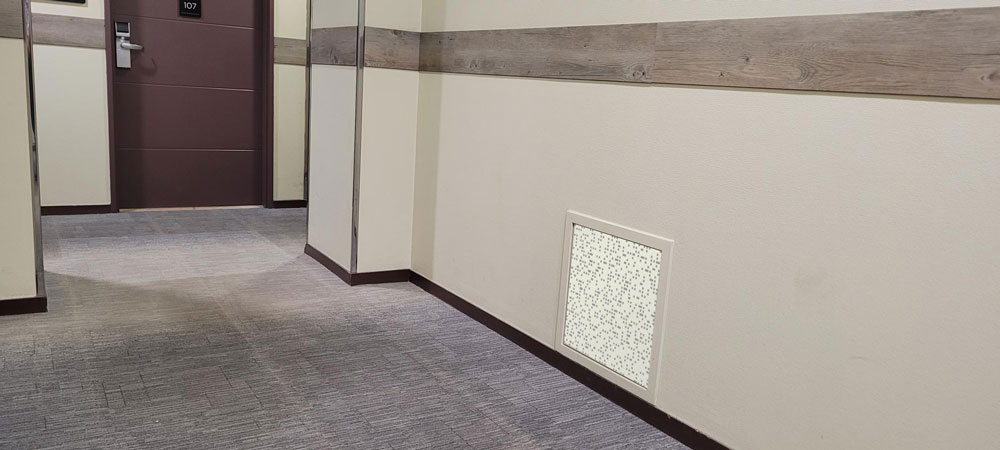
Square radiator cover grille
To easily integrate a decorative square perforated metal sheet as a custom-made radiator cover grille without altering the visual harmony of the space or disrupting the proportions of the project, you need to determine in advance a few elements that will give a different touch to the overall look you are creating. Even if you do it yourself, renovating your radiator cover can add character to the room you are decorating.
- Choose a hole size that is suitable for decoration and ventilation:
Opt for a decorative pattern with orthogonal alignment to better match the square ventilation grille, or choose a regular perforation pattern that fits well with the overall style of the space. Avoid overly large perforations, which may dominate the visual impact of the radiator cover. Holes measuring 5 to 20 mm across, for example, may be suitable, especially if they are repeated in a balanced manner across the entire sheet metal. Certain patterns commonly used in heritage decoration and renovation for ABF (Architectes des Bâtiments de France) enhance the radiator grille, especially in a brass finish, such as the Ditche decorative grille, which is popular for Haussmann-style buildings in Paris. For a natural convection effect between the warm air from the radiator cover and the cool air in the room, avoid holes smaller than 5 mm in diameter, as these slow down the natural air flow.
- Comply with the transparency ratio of 30 to 40% empty space:
The transparency of the perforated sheet metal must be in line with the function of the radiator cover grille, which is designed to allow air to pass through while concealing the radiator's heating element. A transparency rate of 30 to 40% for perforated sheet metal ensures good ventilation while maintaining sufficient opacity for a discreet covering effect. An air passage rate of less than 30% will not be conducive to natural convection of the radiator cover. The radiator cover will act more as a heat conductor, which slows down heat diffusion without reducing the contact surface. The room will heat up more slowly, but there will be little loss of heat energy during the heat exchange between the radiator cover and the room to be heated.
Exceeding a 50% open area threshold does not improve the performance of natural convection, but does reduce the decorative effect. At 60% open area, it is no longer a radiator cover grille, but a simple decorative grille, which is less acceptable in a living room.
- Adjust the dimensions of the perforated sheet metal to fit the radiator cover frame:
Using the radiator grille configurator, cut the perforated sheet metal to the exact dimensions of the radiator cover frame in square proportions so that the grille fits perfectly with the edges of the correct size, providing a solid strip of 5 to 15 mm to attach to the wooden frame. A thin rectangular grille will complete the air exchange area. Assembling a main square with a rectangular complement provides a balanced look, ensures that the design remains intact, and preserves the proportions of the project.
- Alignment with other decorative elements:
The radiator grille fits into a space with other elements of different geometric shapes, such as rectangles or arches. Ensure that the decorative pattern of the perforated sheet metal is properly aligned to maintain visual harmony. Symmetry is essential for the grille to blend naturally into the existing design. Generally, square geometry works well with other shapes.
- Use suitable fasteners:
Choose thin, inconspicuous fasteners, such as flat-head rivets or clips that blend into the frame, to ensure that the overall look remains elegant and that the fasteners do not detract from the radiator cover by adding unnecessary bulk. In some contrasting cases, it is advisable to use large screw heads or even large-headed blind rivets to give the radiator cover an industrial look. It's up to you to choose the style that suits you best.
- The perforated sheet metal finish enhances the radiator cover:
The RAL color and texture of the perforated sheet metal must match the rest of the room. Powder coating in a neutral shade or one that coordinates with the radiator frame will enhance the harmonious look without distracting from the object's main function. By choosing a strong or subtle contrast for your radiator cover, you can give your interior design project a different feel.
How to use a square to conceal a ventilation hole on the main facade of a building
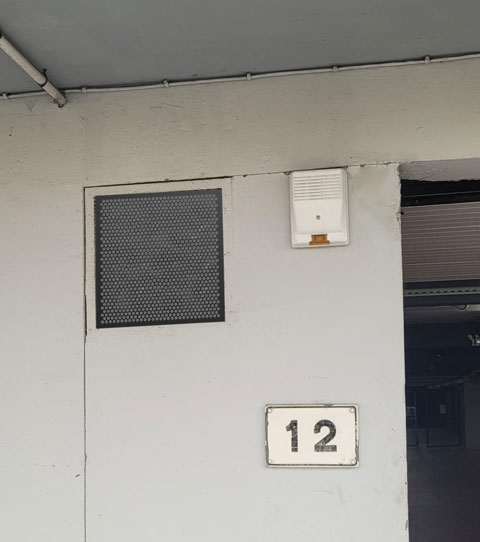
To make the best use of a square geometric frame as a ventilation cover on the main facade of a city building, several decorative and urban aspects must be taken into account, and above all, care must be taken to maintain the performance necessary for proper ventilation of the facade. The detailed explanation below also provides a solution for round ventilation openings in facades that are rectangular, irregular, or poorly made when cutting brick/concrete to install the air exhaust duct.
- Universal adaptability of the perforated square:
The square perforated sheet metal frame can be adjusted to conceal different types of ventilation holes, regardless of their shape or precision when cutting the facade. Thanks to its symmetrical geometry, it effectively covers irregular or poorly finished openings, creating a uniform and neat appearance on the facade. With its four axes of symmetry, the perforated square frame on a facade creates a beautiful graphic effect that softens the presence of the perforated sheet metal on the facade. These axes of symmetry create perfect balance, giving a sense of harmony and elegance to the metal piece added to the facade. The perforations add texture and play with light, while the geometric structure brings both modernity and sophistication, integrating perfectly into an urban design. In addition to its aesthetic appeal, the perforated frame provides natural ventilation directly into the opening created on the façade.
- Ease of installation of square perforated sheet metal:
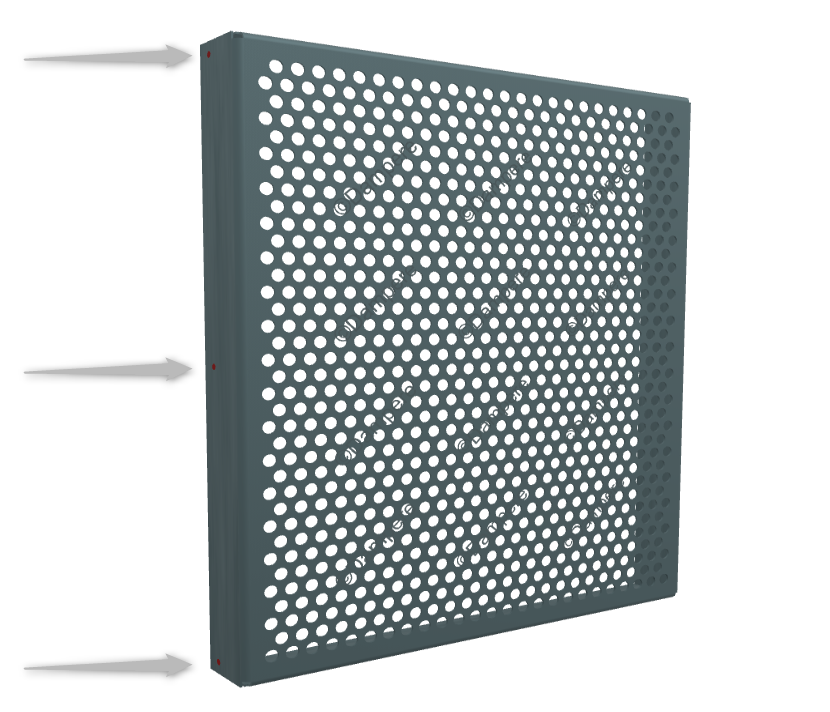
Square frames offer straight lines and precise angles, making them easy to align and attach to the facade. This geometry allows for 6 mm diameter round holes to be placed in each corner of the frame for fastening, ensuring increased stability and durability in bad weather and wind, without the risk of movement or deformation. Using the configurator, it is easy to prepare a custom-made perforated sheet in a folded cassette frame with mounting holes.
Example of an R10T15 Rafa perforated sheet Rafa to be installed for the ventilation of an air duct on a facade, custom-made with mounting holes.
- Harmonious and modern aesthetics:
Aesthetically, a square frame gives the building's facade a clean, modern look. Its symmetrical, simple design fits well with most modern or older architectural styles, adding a decorative element without drawing too much attention. This helps maintain an elegant façade without highlighting the presence of any ventilation mechanisms or imperfections in the underlying openings.
- Optimal camouflage effect of perforated sheet metal:
The square shape of the perforated frame creates a sort of "cover" that hides the hole while maintaining a neat appearance from the outside. For non-standard openings (irregular or asymmetrical), the square frame offers a "visual reframing effect" that diverts attention from the original flaws, adding a symmetrical and harmonious touch.
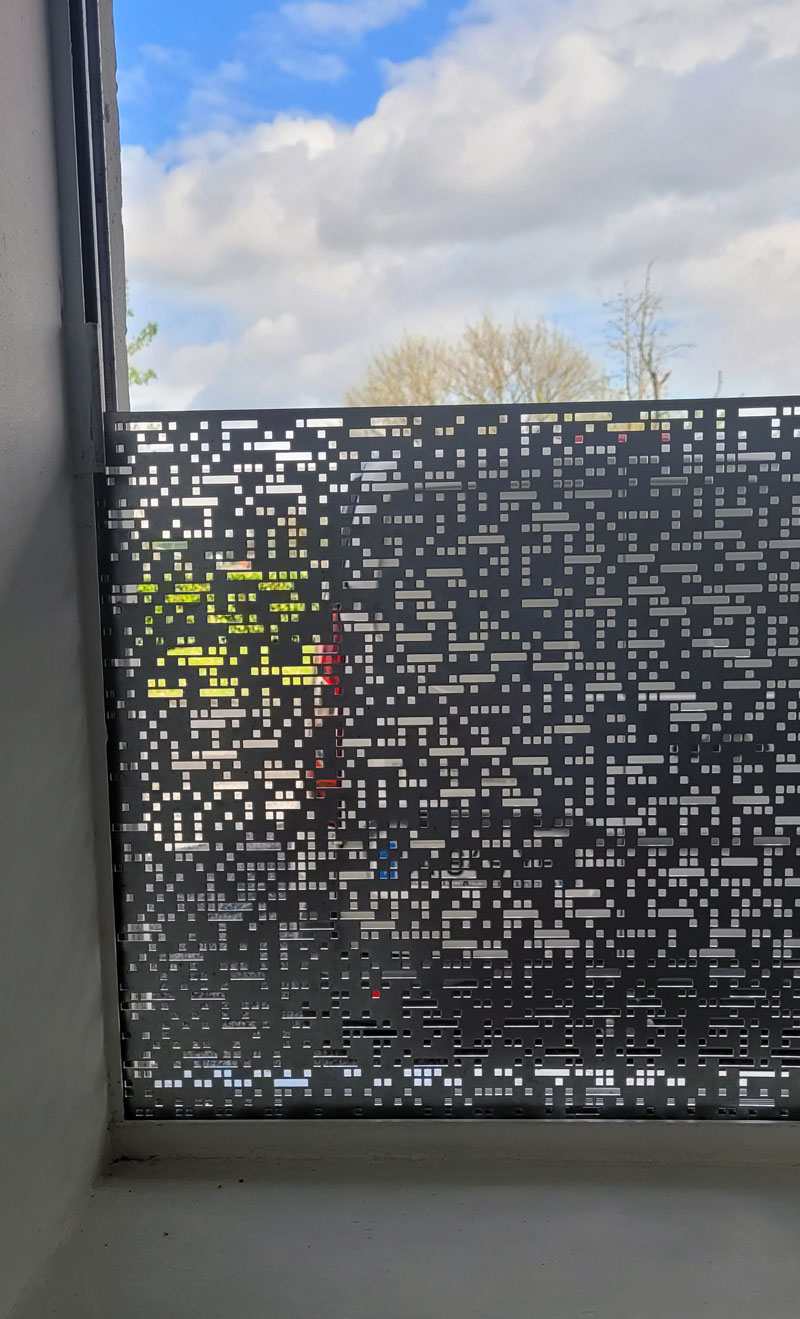
A square frame can also be used to install a privacy screen that protects against prying eyes from outside the building.
- Adaptability to decorative patterns:
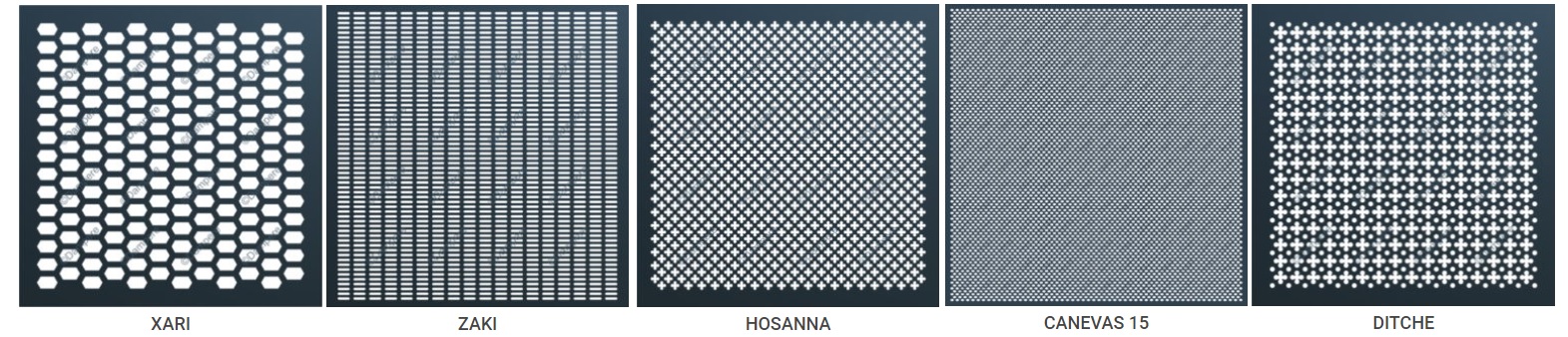
With a square frame, it is easy to play with decorative patterns on the ventilation grille. Whether the grille is perforated in a regular pattern, with geometric cutouts, or even more artistic designs, the square frame naturally frames these patterns, adding an interesting contrast to the façade.
- Practicality of ventilation:
A well-fitted square frame allows for optimal ventilation without loss of efficiency. By adding a perforated or openwork grille to the square frame, ventilation is maintained and the frame acts as a visual deflector, preventing direct views inside, while ensuring effective ventilation. The perforated sheet metal obscures the view and allows 30% to 60% of air to pass through.
Use a series of perforated metal squares to decorate the interior.
In interior design, several styles of inspiration are good for accompanying a project. If you use a series of perforated sheet metal squares, you will achieve a decorative effect that is both innovative and simple in a renovated interior.
A first inspiration for wall decoration would be to create volume, with different depths, by playing with the wall surface. You can arrange the square decorative panels in different layers with a slight offset to give depth. By using shims of different lengths, you can use depth and perspective to bring the perforated metal squares to life. The fixings position each panel slightly forward or backward in relation to the others. This adds an interesting visual effect of relief on the wall without complicating the installation. Volume takes shape in the room without complicating the mechanism for installing the perforated sheet metal. Play with different shades of color, such as shades of gray and black, mixing RAL 7046 gray with the lighter RAL 7047 shade and RAL 7045 for a slightly darker tone. Adding different sizes of wall decoration squares from the custom perforated sheet metal configurator adds an extra touch of design.
Place LED strips behind the panels so that the light shines through the perforations, creating a play of light and shadow on the wall. This enhances the depth effect of the wall decoration.
Another way to add dynamism to your wall decoration is to arrange perforated sheet metal mosaics asymmetrically. Rather than arranging the panels in a perfectly aligned grid, vary the heights and angles of rotation of a few panels to create an asymmetrical mosaic composition. This method of assembling perforated sheet metal squares maintains simplicity while adding a touch of originality to the interior walls of your home. If you want to be more creative, you can combine different finishes. You can use perforated panels in different colors while keeping the same square dimensions. For example, alternate between panels with a satin or glossy finish and panels with an aged or brushed metallic effect in a single direction.
Transition is an important element in creating dynamism. By using perforated metal panels in various modules, we obtain geometric patterns by combining several square perforated panels of different sizes. Juxtaposing 120×120 cm, 40×40 cm, and 60×60 cm panels creates a visual effect of expanding modules. In addition, the gradual transition of perforations through the use of different sizes, from the R5T8 VIPO pattern to the R8T12 RUN model, then the R10T15 RAFA perforated sheet followed by R15T20 KHA, from the smallest round hole to the largest round hole in perforated sheet metal, creates a smooth transition effect across the entire surface. This allows for a transition from an opaque area to a more open area on the wall surface.
The plant dynamic always works. If you incorporate natural elements, add small potted plants or natural elements next to the panels so that the foliage protrudes from the perforations, adding an organic and lively touch. You can also combine perforated frames with laser-cut plant frames as shown below.
How much does a custom wall tile cost?
A square sheet metal panel is often more economical to produce than more complex shapes such as tapered rectangles or trapezoids. The purchase price of a square perforated metal panel is economical thanks to several factors, both industrial and geometric.
Optimizing the raw material allows for minimal waste during production.
The base sheets used in industry are generally rectangular with a width/length ratio of 2. To produce square panels, cutting is simpler because the panel can be cut into two perfect squares, and the raw material used offers a more uniform layout, reducing waste or "scrap" material. When using shapes such as slender rectangles or trapezoids, there is often additional metal loss due to cutting at different angles or the need to remove more material to achieve the desired shape.
The decorative square shape simplifies production, resulting in a better purchase price. Square shapes require fewer configurations in cutting machines compared to complex shapes. A square sheet can be cut in a single step without any special adjustments, reducing production time and, therefore, production costs.
For rectangles with different proportions or trapezoidal panels with sharp corners, the machine settings must be adjusted, which increases setup time and manufacturing complexity.
Laser cutting a square panel generally requires less precision from the Design Office than more specific shapes such as trapezoids, where each angle must be exact. This means that there are fewer quality checks and adjustments to be made, reducing the labor required and the costs associated with production.
At the end of production, square shapes are easier to stack and transport compactly, optimizing space and reducing logistics costs. Trapezoids or rectangles of different sizes can create empty spaces in pallets or containers, reducing transport efficiency.
This means that the price per square meter of a custom-cut panel is the lowest on the market thanks to the best purchase price in relation to surface area, varying between €40/m² and €80/m² depending on the material chosen to make the custom metal panel.
