
Persienne sheet metal Persienne electrical transformers
The use of persienne panels as integral cladding for a block housing an electrical transformer station in an area combining commercial and residential activities offers numerous advantages, both in terms of technical necessity and aesthetic appeal. In this context, the increase in electrical power requirements due to the development of the commercial area with the installation of several restaurants, a bakery and a butcher's shop requires higher electricity consumption. A larger transformer must be installed to meet the cumulative production peaks and the needs of households living in the new homes. However, the visual integration of the electrical transformer into the urban environment is essential to preserve the architectural harmony of the project. persienne sheet metal is therefore a strategic choice for transforming a massive piece of technical equipment into a discreet and aesthetic element.
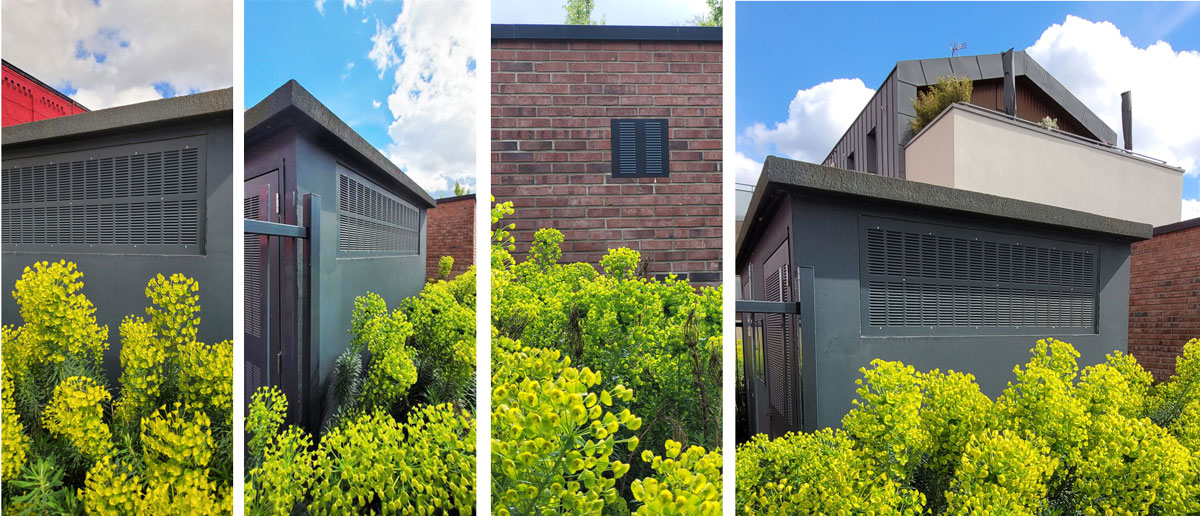
In terms of functionality, steel persienne cladding offers an ideal solution to meet the technical needs of transformers. Iron louver sheets ensure optimal natural ventilation, which is essential for dissipating the heat generated by the equipment, thus preventing overheating and extending the service life of the installations. The slanted slats allow for continuous air circulation while preventing direct penetration of rainwater, thus ensuring reliable protection against the elements. This ability to combine ventilation and protection is crucial to ensuring the proper functioning of an electrical installation of this importance, particularly in a densely populated area where the reliability of the electrical grid is paramount.
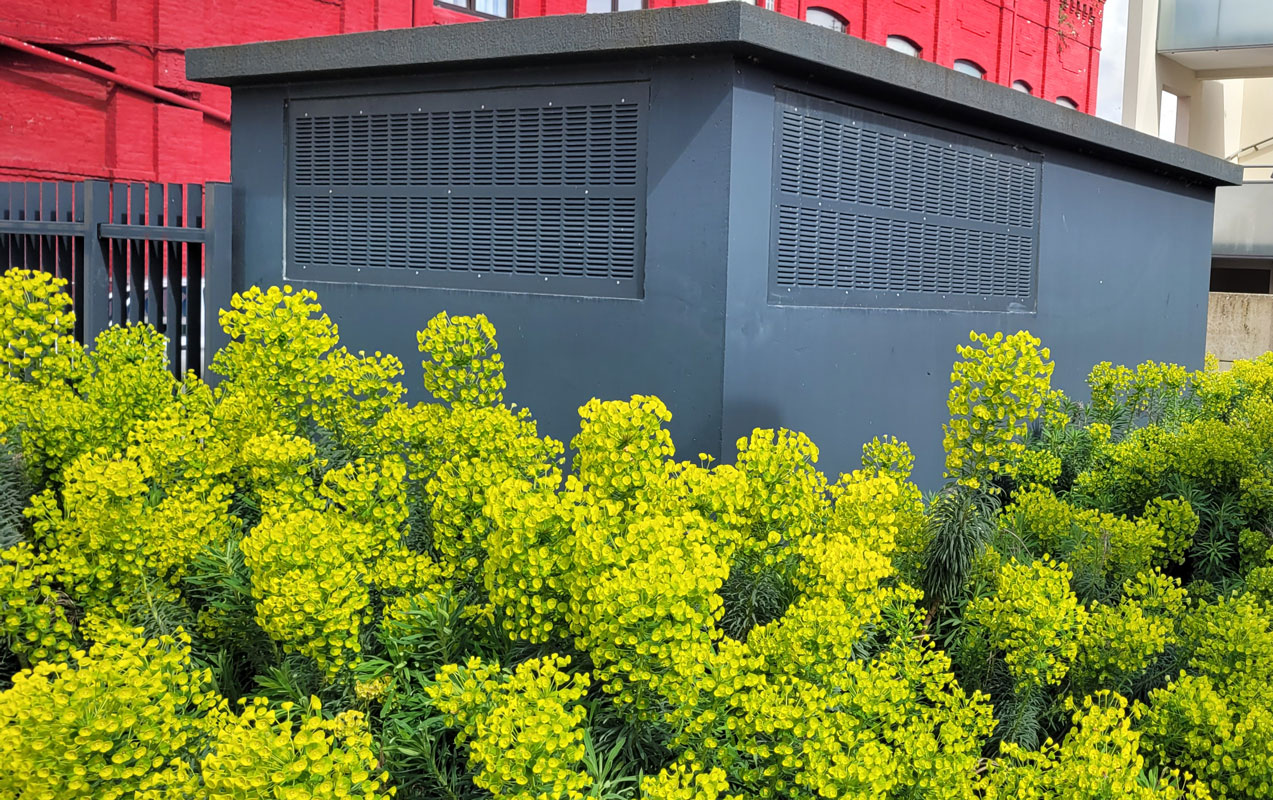
From an aesthetic point of view, the louvers play a central role in the urban integration of the electrical transformer. The choice of a RAL 7015 color suited to the project, in harmony with the tones of the neighboring buildings, allows the cladding to blend naturally into the urban landscape. The louvers cover not only the walls but also the technical doors, creating visual continuity that unifies the entire block. This choice is particularly relevant in a context where the design of infrastructure must not disrupt the overall aesthetics of the area. The sleek finish of the persienne cladding highlights the simplicity and modernity of the project, while offering a subtle but elegant contrast to the architectural balconies of the surrounding apartments. This contrast adds a dynamic visual dimension, while maintaining a graphic continuity between the different elements of the urban landscape.
The integration of steel louvers is not limited to their individual aesthetics, but also extends to their interaction with other components of the project. Aligned horizontally with the brick joints of the surrounding masonry, they reinforce the visual consistency between the transformer cladding and the adjacent walls. This attention to architectural detail creates a symbiosis between the technical aspect and the built environment, making the technical block a natural extension of the surrounding buildings rather than an intrusive element.
In addition, landscaping elements enhance the integration of the persienne cladding into its surroundings. The combination of a bar fence and carefully selected plants creates a setting that is both functional and pleasant in the city, where nature softens the technical appearance of the transformer. Lush vegetation and landscaping accentuate the concealment of the technical block, while adding a touch of greenery that enriches the living environment for residents and visitors. This balance between technology and nature contributes to the perceived quality of the project and the attractiveness of the area.
Persienne sheet metal
persienne sheet persienne is a versatile solution that is well suited for technical installations in urban environments, thanks to its combination of high technical performance and aesthetic appeal, which makes it ideal for integration into city centers, close to homes and businesses. Persienne perforated sheet metal has been designed for centuries to meet ventilation and protection needs without any particular innovation, as it fulfills those requirements. persienne provides optimal air management while ensuring protection and security against the elements.
The persienne sheet metal persienne the temperature.
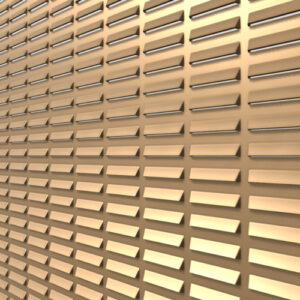
Temperature management is a key function of the ventilation grille. The slanted openings in the iron louvers promote natural air circulation, which rises naturally to the top of the perforated sheet metal due to convection, which is accentuated by the greater the temperature difference within the technical equipment. The greater the temperature difference between the bottom of the installation and the top of the equipment, the stronger the natural convection will be. This is thermal performance without the need for energy consumption to ensure performance. For natural convection to work well, the persienne sheet metal must be as tall as possible to ensure the temperature difference. The thermal conductivity of steel also plays a role in heat dissipation to prevent the operating temperature limits of the machines embedded in urban equipment from being reached. This characteristic helps maintain a stable temperature inside technical installations, reducing the risk of overheating or condensation, two factors that can lead to costly failures or service interruptions. Moisture accumulation is a common problem in technical rooms housing electrical, telecommunications, or hydraulic equipment.
The persienne sheet metal is persienne to mechanical impact.
Mechanically speaking, the 1.5 mm thick steel used for the louvered panels is exceptionally robust, offering high resistance to accidental or intentional impacts. In urban environments where there is a risk of vandalism or frequent wear and tear due to impacts (bicycles, scooters, electric scooters, etc.), the robustness of thick metal is a major advantage for persienne Dampere. In addition, surface treatments such as Sendzimir Z275 steel sheet galvanization, complemented by the application of RAL-colored epoxy paints in an oven, reinforce corrosion resistance, ensuring increased durability even in harsh climatic conditions accompanied by urban pollution. These treatments protect the surface of the 1.5 mm galvanized persienne sheet against the elements, extending the life of the installation and reducing maintenance costs. At the same time, the design of the iron louver sheets plays a crucial role in protecting against water infiltration. The slanted metal slats effectively prevent direct rain penetration while maintaining continuous ventilation, which is essential for sensitive areas where water could compromise the operation of urban equipment such as electrical transformers or telecom network relays.
The persienne sheet metal persienne the safety of the installations.
Security is another key aspect for which persienne panels are particularly well suited in urban environments. Thanks to the rigidity of steel, these metal panels provide a reliable physical barrier against intrusion and theft. This protection is essential for facilities such as electrical substations, telecom rooms, and pumping stations, which are often located in areas accessible to the public. In addition, metal louvered panels can be designed to incorporate locking systems or additional internal grilles, further increasing the level of security while maintaining a neat appearance from the sidewalk. Aesthetics are a key consideration in urban environments, where these installations must blend harmoniously with the surrounding infrastructure and the framework set by local urban planning regulations. Galvanized persienne panels offer a minimalist industrial aesthetic that can be easily customized. Thanks to a wide range of available finishes, such as powder-coated paints in various RAL colors, these panels can be adapted to local architectural codes or the preferences of urban architects, allowing for discreet visual integration or, conversely, aesthetic enhancement.
Beyond their functionality, louvered panels also add a design dimension, playing on the interplay of light and shadow created by the relief of the slanted slats. This mechanical embossing offers an aesthetic dimension that adds visual texture, contributing to the beautification of technical facade cladding and making these urban infrastructures not only functional but also visually appealing. In some cities, these panels can even become architectural elements in their own right, integrating into landscaping or urban development projects. This ability to combine aesthetics and functionality is particularly valuable in contexts where public perception of technical infrastructure is important, as it avoids polluting the residential environment with technical blocks. For example, in residential or commercial areas, a well-designed and visually harmonious installation can help reduce the perceived impact of these technical facilities on the urban environment.
The persienne sheet metal persienne to the architectural design.
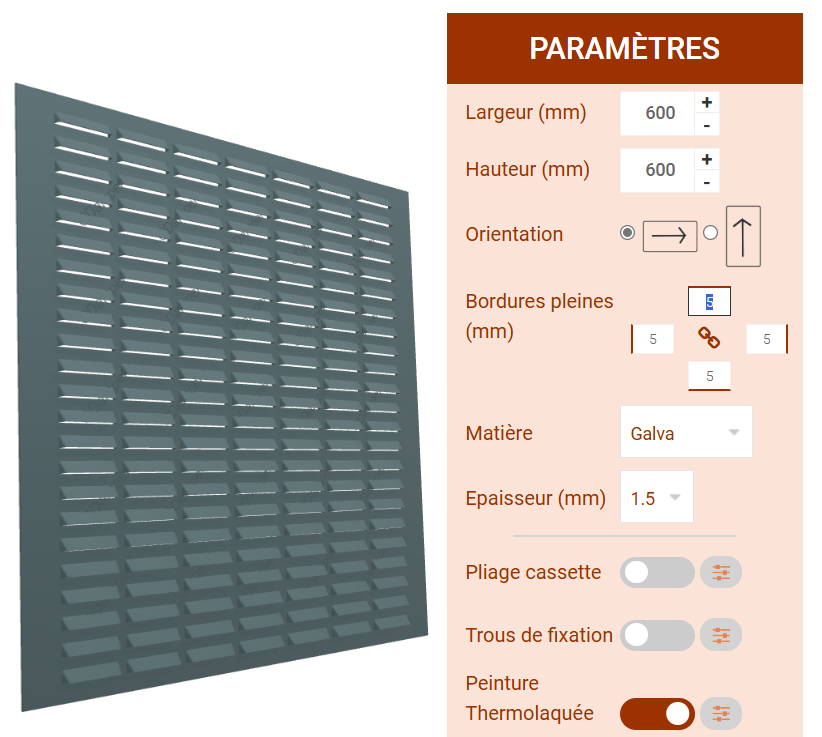
The flexibility of use of persienne sheet persienne is another major advantage. Manufactured by a numerically controlled stamping machine, the panel is available in different sizes, adaptable in terms of edges and number of cutouts, choosing the number of rows and columns to be produced. The persienne adapted to the specific needs of each technical application by adjusting its air passage section in cm² of space for ventilation.
The persienne sheet metal is made on a steel panel of different shapes. It can be a vertical rectangle to cover the door of a transformer measuring 1800 x 800 mm or a horizontal rectangular panel measuring 600 x 1200 mm placed on the side wall of an electrical transformer station. Sometimes, for simple ventilation, a small square persienne grille measuring 550 x 550 mm or a round grille with a diameter of 600 mm embossed with a persienne pattern persienne the center is required. For sloping ground or to cover the stringers of a metal staircase, we can produce a trapezoidal or parallelogram-shaped panel with persienne slits persienne the persienne perforated sheet persienne configurator.
Whether for ventilation grilles, facade cladding, or privacy screens, these ventilation panels are custom-made to meet technical requirements while blending into the architectural environment. Furthermore, their ability to conceal technical equipment without compromising its operation or accessibility makes them an ideal solution for densely populated areas where space is limited and urban aesthetic requirements are high.
persienne a CSR environmental approach
Finally, the durability and efficiency of persienne panels make them a solution that complies with sustainable development principles. By promoting natural ventilation, persienne grilles reduce the need for air conditioning or mechanical ventilation systems, thereby lowering energy consumption for cooling urban technical equipment. The material's longevity and resistance to external aggressions also minimize the need for frequent replacements, which helps reduce the ecological footprint of installations in the long term. In the current context of increasing urbanization and the search for sustainable technical solutions, these characteristics reinforce the appeal of persienne sheet persienne as a first-rate choice for a multitude of technical and architectural applications in cities.
Persienne sheet metal Persienne urban facilities
What technical equipment is available in the city?
The dimensions of the structures required to house technical equipment vary depending on the application. For electrical substations and secondary transformers, the average width is 6 meters, the length is 10 meters, and the height is 4 meters, providing sufficient space for the equipment while allowing for adequate air circulation. This represents a volume of 250 m3 that must be successfully concealed in the urban environment. Pumping stations and water tanks are often more compact technical installations in cities, with an average width of 5 meters, a length of 8 meters, and a height of 3 meters, which are ideal dimensions for integrating the necessary systems while remaining discreet and quiet. Technical rooms dedicated to office air conditioning, cold room refrigeration, or heat pumps are generally smaller thanks to the latest generation of air compressors. These urban technical installations have an average width of 4 meters, a length of 6 meters, and a height of 3 meters, meeting the needs of proper operation and efficient ventilation.
In other cases, when the power required must supply a larger capacity, we therefore find heavier buildings. Industrial facilities in industrial parks and commercial facilities in commercial zones, which are often large, have average dimensions of 12 meters wide, 20 meters long, and 6 meters high, allowing for the integration of several pieces of equipment or treatment areas. Similarly, water treatment and waste management systems require an average width of 9 meters, a length of 15 meters, and a height of 5 meters to house large pumps, filtration devices, and aeration equipment.
Risks associated with technical equipment
Local urban facilities require isolated spaces that are protected from the public to ensure the safety and proper functioning of the equipment. They sometimes need to be installed in city centers to ensure optimal performance, but must be secured at all times due to the dangers posed if they were freely accessible to the general public. Some installations pose a mortal danger. Their integration into the urban environment is therefore a challenge, especially in terms of ventilation or aeration to prevent heat build-up or high humidity levels.
Energy and distribution facilities in urban areas
- Secondary electrical substations
A secondary electrical substation is an essential facility in the electrical distribution network. Its main role is to convert high-voltage electricity, transported from source substations or transmission lines, into a lower voltage suitable for the needs of end users, whether households, businesses, or industries. This electrical transformation process ensures safe, stable, and efficient distribution of electricity.
These substations are usually located near areas of consumption, such as residential neighborhoods, commercial areas, or industrial sites. Secondary substations typically reduce the voltage from 20,000 volts (medium voltage) to 400/230 volts (low voltage), the standard for domestic and commercial power supply.
In addition to transforming voltage, these substations manage and protect the local grid against overloads, short circuits, and other electrical incidents. Their proper functioning is essential to maintaining a continuous power supply and ensuring the safety of facilities and people connected to the grid. Transformer substations pose electrical hazards (electric shock, electric arcs) and fire hazards in the event of overload or failure. Average power: 250 kVA to 1 MVA (electric).
- Electric vehicle charging stations
Electric vehicle charging stations may present risks of terminal overheating, battery fire in the event of failure, and electrocution. Average power: 50 to 350 kW (electric).
Fluid management infrastructure
- Underground or semi-underground water tanks
Underground water tanks in cities play a vital role in water resource management, particularly in densely populated urban environments. These infrastructures are designed to store drinking water, industrial water, or rainwater, while optimizing the space available in urban areas thanks to their underground integration. Their strategic location allows them to quickly meet the needs of residents, businesses, and industries.
Drinking water reservoirs ensure a stable supply, even during periods of high demand, and also serve as a reserve for emergencies, such as fires or network failures. In the case of rainwater, they collect and store rainwater to prevent flooding during periods of heavy rainfall. This water can then be reused for non-potable purposes, such as irrigation or urban cleaning, thereby contributing to sustainable resource management.
These installations must be robust, protected against contamination, and equipped with ventilation systems using louvered metal panels to prevent the accumulation of moisture and gas. Their design and maintenance are crucial to ensuring their effectiveness and harmonious integration into the urban landscape. Underground water tanks pose a risk of contamination of stored water, as well as risks related to unstable structures or slab collapse. Proper ventilation through persienne metal sheets persienne necessary to prevent water condensation, which is damaging to all load-bearing structures.
- Measuring and control stations for water or gas networks
Gas regulating stations are key infrastructure in the natural gas distribution network. Their main role is to reduce the pressure of gas transported through high-pressure pipelines to make it compatible with domestic, commercial, or industrial installations. These stations act as intermediate points between the high-pressure transmission network and the medium- or low-pressure distribution network.
At a regulating station, gas passes through specialized equipment such as valves, pressure regulators, and measuring devices. These components reduce and stabilize pressure while maintaining a constant safe flow rate. The stations are also equipped with safety systems to prevent overpressure, leaks, or breakdowns, such as relief valves and gas detectors. Some stations also preheat the gas, as its expansion can cause a drop in temperature that could freeze the equipment.
Located near urban or industrial areas, these stations must meet strict safety and environmental integration requirements. Their proper functioning is crucial to ensuring a continuous and secure gas supply, while protecting downstream infrastructure and end users. Gas regulating stations pose a public risk of explosions due to overpressure, or poisoning in the event of a gas leak. Good ventilation will prevent the formation of gas pockets.
Telecommunications equipment and technologies
- Technical cabinets for telephone networks
Telecom network cabinets are essential technical infrastructure for the operation of modern telecommunications networks. Installed in urban and rural environments, they serve as distribution and interconnection points between different segments of the network, including fiber optic lines, telephone cables, and sometimes even mobile antennas. These telecom network cabinets manage and protect the electronic equipment needed to transmit data, calls, and other digital services.
Typically, a telecom network cabinet houses optical modules, switches, splitters, and power supplies. They also terminate fiber or copper cables and redistribute connections to end users or other equipment. These telecommunications cabinets must provide a secure environment for these devices, protecting them from the elements, dust, and extreme temperatures with built-in ventilation or air conditioning systems.
In addition to physical protection, these cabinets are often equipped with anti-vandalism devices and controlled access to ensure infrastructure security. Their strategic location in residential or industrial areas guarantees reliable and constant service, meeting the growing connectivity needs of modern environments. Telecom network cabinets present low electrical risks (1 to 5 kW). At close proximity and over a long period of time, electromagnetic interference may occur. Due to their high urban exposure, network cabinets are often subject to vandalism.
- Substations or relay antennas for 5G
4G and 5G relay antennas pose a risk of exposure to radiofrequency waves, electrical hazards, or fire. The electrical power used is around 30 kW.
- Local modular data centers
Small data centers are being deployed in city centers to provide proximity to services. They pose risks of overheating, electrical fires, and electromagnetic interference. The power used ranges from around 300 kW to 1 MW (electric).
Light industrial infrastructure
- Compression or decompression stations for industrial gases
Compressed gas stations are specialized facilities used to compress, store, and distribute high-pressure gases for industrial, commercial, or transportation applications. These gases may include compressed air, nitrogen, oxygen, hydrogen, or natural gas, depending on specific requirements. The stations play an essential role in supplying compressed gas to various industries, as well as to hospitals for medical gases.
A compressed gas station typically consists of compressors, storage tanks, pressure regulation systems, and sometimes filtration devices to ensure gas purity. Compressors increase gas pressure to optimize transport and reduce the volume required for storage. High-pressure tanks safely store compressed gas prior to distribution.
The risks associated with compressed gas stations include leaks, explosions due to overpressure or ignition, and environmental hazards in the event of poor containment. For this reason, these stations incorporate advanced safety systems, such as relief valves, leak detectors, and cooling devices. Strategically placed, they ensure an efficient and secure supply for their end users. Explosions in the event of leaks or overpressure, gas poisoning for 50 to 200 kW (mechanical).
Transportation and urban infrastructure
- Garbage rooms or municipal waste
Garbage rooms are spaces dedicated to the temporary storage of waste produced by residents, businesses, or companies before it is collected by waste management services. They are essential for ensuring organized and hygienic waste management, particularly in densely populated urban areas.
These premises must be designed to accommodate containers or bins of different sizes, often for several categories of waste: residual household waste, recyclables, green waste, or bio-waste. Good ventilation using perforated metal persienne essential to prevent the accumulation of unpleasant odors and limit the health risks associated with waste decomposition. Metal ventilation grilles or mechanical ventilation systems are often incorporated.
Safety and accessibility are also important: the premises must be easily accessible to residents and waste collection agents, while also being secure to prevent access by pests or unauthorized persons. As part of an aesthetic and functional integration, these premises can be concealed by perforated metal sheets with a plant-inspired design to blend harmoniously into the urban environment.
- Community equipment shelter
A community equipment shelter is a structure dedicated to the secure storage of equipment and tools needed for collective activities in a community or public space. These shelters are often used to store maintenance equipment (shovels, brooms, lawnmowers), temporary street furniture (mobile benches, barriers) or sports and leisure equipment (balls, nets, tables).
Located in parks, residential areas, or shared spaces, these shelters play a key role in organizing community activities and maintaining shared infrastructure. They are designed to provide optimal protection against inclement weather, moisture, and vandalism. The structures are generally made of resistant materials, such as perforated metal, and equipped with locking systems to ensure the security of the contents.
- Technical stations in underground parking lots
Technical stations in underground parking lots are spaces dedicated to the installation and operation of equipment necessary to ensure the safety, comfort, and operational efficiency of parking lots. These stations house critical systems such as mechanical ventilation, fire protection devices, gas detection systems (carbon monoxide and nitrogen dioxide), electrical transformers, lighting control units, and pumps for managing rainwater or infiltration.
The main role of these stations is to ensure a safe environment for users by eliminating risks related to exhaust fumes, fires, or humidity. Ventilation systems allow for air renewal and the removal of pollutants, while fire safety devices, such as automatic fire extinguishers or smoke detectors, ensure a rapid response in case of emergency.
Technical stations are generally isolated from the rest of the parking facility and must meet strict standards in terms of safety and ventilation. They are often equipped with fire-resistant doors and perforated metal sheets or louvers to allow natural ventilation while protecting the equipment. These installations ensure the smooth operation of the parking facility and contribute to user safety.
- Railway or tramway technical rooms
Railway technical rooms are essential infrastructure for the smooth operation of rail and urban transport networks. They house critical equipment related to signal management, power supply, telecommunications, and sometimes air conditioning or ventilation for underground systems. These rooms may be located near the tracks, in depots, or integrated into station infrastructure.
These spaces house transformers, rectifiers, inverters, electrical cabinets, control systems, and communication devices. Their role is to guarantee a stable power supply for trains or trams, manage signals for traffic safety, and supervise the overall operation of the network using automated systems. They also play a crucial role in fault management and equipment maintenance.
Tramway technical facilities must meet strict safety requirements, particularly with regard to electrical hazards, fire, and vandalism. They are often protected by sturdy enclosures, such as metal panels or perforated sheets, which allow for adequate ventilation of the equipment while blending harmoniously into their surroundings. These installations ensure the reliability and safety of rail and tramway networks.
