
Rectangular frame made of perforated sheet metal
Custom-made rectangular perforated metal panels offer a versatile metal solution that is perfectly suited to a variety of uses, whether decorative, structural, or related to human safety. Their clean, modern rectangular geometric shape makes them an ideal choice for contemporary architectural projects without being simplistic. Thanks to their ability to be customized in different sizes, these panels can transform an ordinary wall into a dynamic and artistic composition, playing with proportions and empty spaces to create a captivating visual effect. By incorporating decorative patterns using computer-controlled punching, these rectangular panels made of perforated metal decorative patterns add a sophisticated aesthetic dimension while retaining essential functionality.
The use of designer metal frames is not limited to wall decoration. Rectangular metal frames made of perforated sheet metal are also ideal for structural applications, where they can be used to reinforce the stability of buildings while providing an aesthetic solution. For example, standard 2000 x 1000 mm rectangular perforated sheet metal can be integrated into balcony railings, modern metal facades, or urban fences to ensure both safety and design. The ability to play with patterns and textures using PCN Computerized Perforation allows you to create elements that not only protect but also enrich the architectural environment.
When it comes to decoration, rectangular metal panels can be arranged to create repeating patterns or asymmetrical arrangements that capture the eye. These compositions can serve as a focal point in a room, drawing the eye and adding an artistic touch to the interior space. In addition to their aesthetic appeal, the flexibility of rectangular perforated metal sheet sizes allows these panels to be adapted to specific spaces, such as corners or areas between windows, which are often difficult to decorate with other geometric shapes. Rectangular panels can fill empty spaces in a room while enhancing the overall visual coherence. The goal of decoration is not to fill the room with rectangular panels everywhere! It is about achieving a balance when composing empty wall spaces, painted areas, and sections decorated with one or more rectangular frames.
Rectangular perforated metal panels also offer designers great creative freedom. By playing with colors, textures, and materials, they can create unique visual effects that reflect the style and personality of the space. For example, by combining different decorative perforated sheet metal patterns with a variety of colors, it is possible to create wall compositions that are both functional and aesthetic. This versatility makes these panels suitable for a multitude of applications, ranging from modern interior design to more structural installations.
Finally, perforated sheet metal is used in wall decoration, but fortunately there are many other applications in building decoration and security. For safety, perforated sheet metal panels are often used in applications such as balcony railings, where they provide protection while maintaining a refined aesthetic. Their robustness combined with the possibility of customization makes them a popular choice for projects where safety should not compromise design. The same applies to rigid panel fences, where safety and privacy are paramount. Perforated metal frames are the ideal solution for all project requirements. Below is an example of perforated sheet metal applied to an exterior facade exposed to rain, dirt, and vegetation without risk of premature aging.
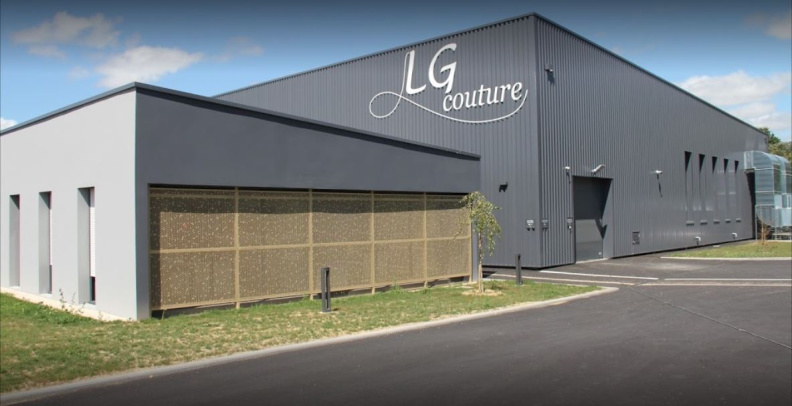
Perforated sheet metal is an obvious choice for construction
Rectangular perforated metal panels are an essential choice for decorative inspiration in all building applications, combining competitively priced perforated sheet metal, a wealth of decorative patterns, impact resistance and modern aesthetics, ease of design, and quick installation thanks to simple systems. Compared to other materials such as expanded metal, glass, or wood, perforated sheet metal stands out for its many advantages, including ease of maintenance.
The strength of perforated steel sheet lies in its industrial production, which is the main argument for choosing it for facade decoration. Perforated sheet metal offers an almost unlimited variety of decorative patterns thanks to digital perforation and laser metal cutting techniques, allowing designs to be customized to the specific needs of the project, whether for decorative or security applications. This flexibility in decorative patterns allows complex design elements to be integrated while maintaining technical functionality and optimal resistance to vandalism.
Secondly, another strong argument in favor of perforated metal panels is their cost! Perforated sheet metal is inexpensive thanks to its industrial production and is often more economical than glass or wood, especially when it comes to large surfaces or projects requiring complex shapes. In addition, it offers superior durability: resistant to corrosion, weather, and impact, it requires less maintenance in the long term compared to wood, which can deteriorate, or glass, which is more fragile. Perforated sheet metal remains inexpensive and will always perform better than wood in the face of rain, frost, and cold.
In terms of strength, perforated sheet metal also outperforms expanded metal thanks to its ability to be thicker while remaining lightweight, making it ideal for applications where safety is paramount, such as balcony railings in public housing or facades exposed to gusts of wind. It combines strength and aesthetics, creating surfaces that are not only protective but also visually appealing. Expanded metal does not offer a wide range of patterns and, above all, poses a safety hazard for children due to the risk of fingers getting caught in the metal slats. Expanded metal should not be used in nurseries, schools, or public spaces where children are present.
Finally, the striking aesthetics of perforated sheet metal, with its ability to create patterns of light and shadow, make it a popular choice for architects and designers. Its ability to filter light while maintaining a certain transparency allows it to create unique metallic mashrabiya effects, which are particularly popular in modern and contemporary projects. Perforated sheet metal can be found in churches, schools, public buildings, public gardens, and in wooden furniture decorated with metal.
Choosing the optimal perforated sheet metal for your application
When choosing and using perforated sheet metal, here are five mistakes to avoid. As with any decoration project, it is essential to take several factors into account to avoid costly mistakes and ensure that the final product meets expectations in terms of performance, safety, and aesthetics.
1. What thickness of perforated sheet metal?
- Optimal thickness for perforated sheet metal: for various indoor and outdoor applications, the optimal thickness of perforated sheet metal is 1 mm for fine decoration and 1.5 mm for structural elements. For example, a 30 cm x 80 cm radiator cover grille will be made from 1 mm thick Ditche perforated sheet metal, while a 60 cm x 150 cm partition screen made from Odin perforated sheet metal will be 1.5 mm thick.
Perforated sheet metal with a thickness of less than 1 mm is extremely fragile and prone to deformation or breakage, especially during installation or under mechanical stress, and should therefore be avoided for outdoor use. This thinness makes the sheet less resistant to impact, strong winds, or pressure, which can compromise safety, especially if the perforated mesh is used for outdoor applications such as guardrails or sunshades. - Safe thickness for perforated sheet metal: for all applications relating to personal safety and site protection against theft or vandalism, a thickness of 2 mm perforated sheet metal is recommended. The mechanical strength of 20/10 perforated sheet metal allows it to withstand urban impacts, offers protection against violent mechanical forces, and prevents deformation. It is important to first install a metal support structure that distributes the forces, with a maximum span of 60 cm between supports. For the safety of perforated sheet metal balconies, most perforated patterns withstand the dynamic guardrail test according to standard NFP-01-013 for a sheet thickness of 2 mm. Similarly, Vigipirate fences are made of 20/10th thick perforated sheet metal.
- Excessive thickness in perforated sheet metal: a thickness greater than 3 mm makes perforated sheet metal difficult to shape. It is industrially possible to perforate 3 mm sheet metal for a Tole Cade Perfo R10T15 Rafa type pattern, which offer a very high mechanical resistance threshold! However, 3 mm perforated sheet metal is very heavy, which complicates its installation and increases handling costs, while its production complexity is higher. Sheet metal that is too thick is more difficult to perforate, increases the power required by the machines, and increases the risk of deformation and breakage of the perforating tools, which greatly limits the patterns that can be produced and increases the cost, both in terms of production and transport. It is crucial to find the right balance for the specific application, generally between 1.5 mm and 2 mm for most projects.
2. Choosing the finish for perforated sheet metal
Raw industrial metal is scratched by definition during the multiple rolling and shaping stages, especially for standard 2000 x 1000 mm perforated sheet metal. Scratch-free sheet metal is only available after several operations involving flattening, deburring, brushing, and protection with plastic film.
Raw metal sheets are prone to scratches and other imperfections after production, especially during handling and transport. These defects can affect the final appearance of the product. To avoid this problem, it is strongly recommended to brush the surface to make it uniform or to apply a protective paint or coating before installation. These finishes not only improve the appearance of the sheet metal, but also increase its resistance to corrosion and weathering, thus extending its service life.
3. Understanding precision and production tolerances
When manufacturing perforated sheet metal, it is essential to take into account industrial production tolerances, i.e., possible variations in the geometric dimensions of the outer contour and the arrangement of holes and spaces between them, as well as the size of solid edges. Ignoring these tolerances can lead to problems during assembly or installation, such as poorly made adjustments or incorrect alignments. Good communication with the Design Office on the subject of perforated sheet metal manufacturing tolerances allows you to understand the specific tolerances of each decorative pattern, ensuring that the perforated sheet metal will perfectly meet the requirements of the design project.
4. Select the size of the perforated holes
The optimal hole size for decorative applications ranges from 5 mm to 15 mm. These dimensions allow for the creation of visually interesting patterns for interior decoration while ensuring a certain degree of opacity for exterior applications. Smaller holes (5-8 mm) can be used for more subtle patterns, while larger holes (10-15 mm) can attract more attention, creating dynamic visual effects. By using perforations of this size mixed together to create abstract patterns, such as Milenium decorative perforated sheet metal, you can play with light and shadows, enriching the overall aesthetics of a space.
Ventilation hole size
For ventilation applications, the holes must be larger, typically between 10 and 30 mm. This size allows for optimal airflow while maintaining a certain level of security. For example, 20 mm holes in Liboma 60% perforated sheet metal offer a good balance between airflow and reduced risk of intrusion or passage of unwanted objects. In ventilation, it is essential to ensure sufficient air flow while minimizing obstructions, which makes these dimensions appropriate for perforated sheet metal. For air passage applications in false ceilings, it is better to use 30% transparency and increase the air diffusion surface area.
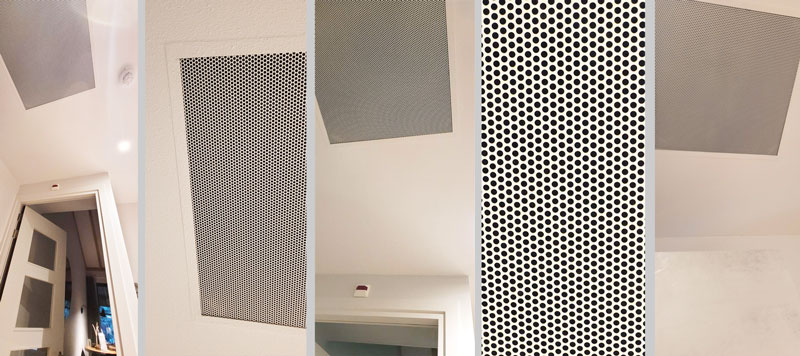
Radiator cover hole size
For custom-made perforated metal covers for radiators, holes measuring 8 to 12 mm are often used. This allows for adequate air circulation while maintaining an attractive design. The holes must be large enough to allow hot air to pass through, but not so large that they compromise safety (risk of burns or snagging) or the overall appearance of the cover. A size of 10 mm is a good compromise that ensures both efficiency and elegance, as in the case of the Ditche brass grille pattern for radiator covers.
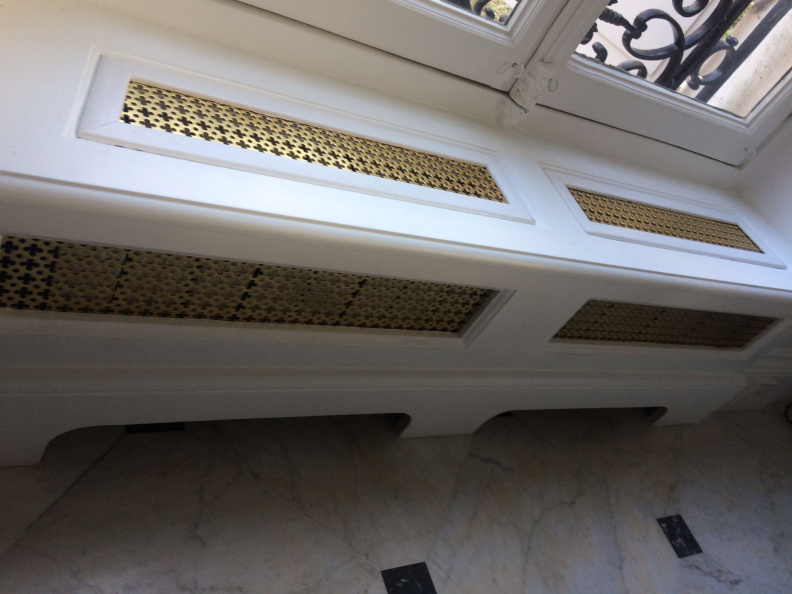
Hole size in guardrail
For perforated sheet metal guardrails, the size of the holes can vary from 5 to 20 mm, depending on the desired level of transparency and safety. Smaller holes (5 to 8 mm) will offer more privacy without the risk of finger trapping, such as Texas perforated sheet metal, while larger holes (15-20 mm) will create a feeling of openness and lightness while maintaining compliance with anti-climbing safety standards, such as R15T20 Kha perforated sheet metal. For outdoor use, it is crucial that the perforations are adapted to provide adequate light and block prying eyes to ensure safety without compromising aesthetics.
Hole size in fence
For fences, the holes must be large enough to provide adequate visibility and ventilation, typically between 10 and 30 mm. A hole size of 15 mm is often ideal, as it ensures security while maintaining a certain degree of transparency, as in the case of the Agostine Magma privacy fence. This is particularly important in urban environments where aesthetics and security are major concerns. The size chosen must also take into account the need for privacy without completely obstructing the view or light.
Front hole size
For decorative facades, the holes must be large enough to provide an architectural facade effect on the building, typically between 15 and 50 mm. A hole size of 20 mm is often ideal to ensure safety while maintaining a certain degree of transparency. This is particularly important in urban environments where aesthetics seen from a distance from the street or a highway are major concerns, such as for the wave-shaped perforated sheet metal facade of the MRS4 Data Center. The chosen size must also take into account the need to identify the project without completely obstructing the view or the light passing through the glazing.
Hole sizes to avoid
Drilling holes smaller than 5 mm in diameter can cause problems, particularly in terms of finish. Paint or protective coatings have difficulty adhering properly to the inside of these small holes, which can lead to poor durability over time. To ensure the durability of custom perforated sheet metal, it is best to opt for perforations with a minimum diameter of 5 mm, allowing for uniform application of coatings. In addition, hole sizes greater than 50 mm should also be avoided as they weaken the metal panel by reducing the number of active nodes.
5. Mechanism for installing perforated sheet metal
Before cutting the perforated sheet metal to size, it is essential to consider the installation system. This includes choosing the fasteners, the assembly method, and taking into account the specific constraints of the installation site and the possibility of dismantling for maintenance. Mechanical fastening with screws or rivets is preferred. The use of a single cassette fold or double side fold provides better panel support with invisible fastening points. The concept of a solid edge or blind peripheral strip provides a contact area without perforations for fastening.
Configurator specifications to assist with selection
Using the perforated sheet metal configurator to select decorative pattern panels simplifies the project construction process while minimizing potential errors, providing clear specifications and customized options at every stage. By selecting the appropriate thickness via the Dampere configurator Dampere suitable finishes, such as folding or RAL paint of your choice to protect the raw metal from scratches and corrosion, you can guarantee a durable and attractive finish. You can thus compose a rectangular metal panel with a custom width and height that differs from the standard 2000 x 1000 mm perforated sheet format. With regard to the size of the perforations, the configurator imposes a minimum size of 5 mm, ensuring good paint or coating adhesion, which is essential for the longevity and aesthetics of the final product. This integrated digital approach not only makes the process easier for users, but also provides assurance against common errors, enabling perforated sheet metal projects that combine functionality, durability, and beauty. The solid edge often varies between 5 mm and 20 mm depending on the application, and the single bend ranges from 15 mm to 50 mm of outer folded return.
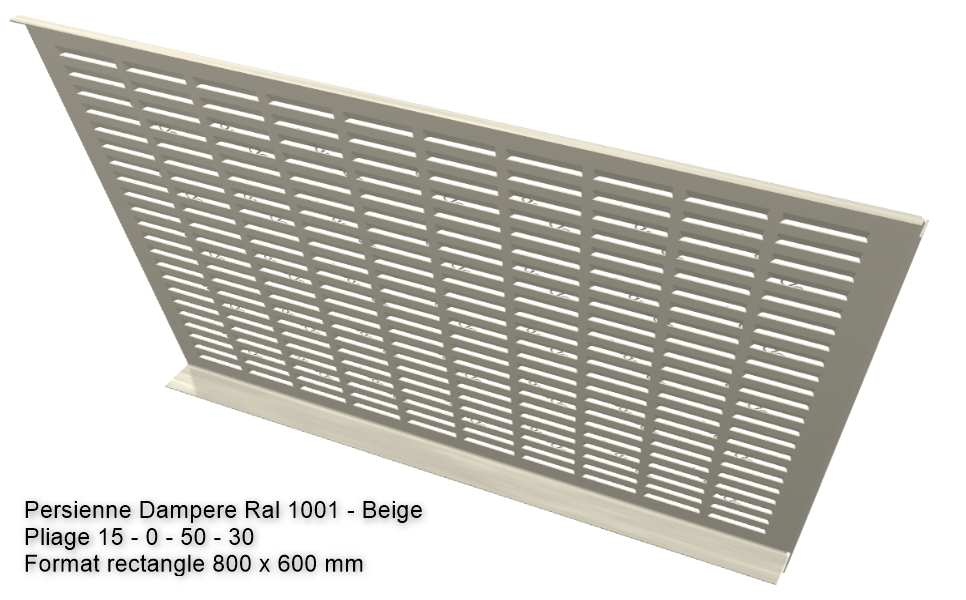
Example of a custom-made rectangular persienne sheet metal persienne measuring 800 x 600 mm with various folds, painted in RAL 1001.
Why is perforated sheet metal the best choice for fencing?
Perforated sheet metal is an excellent choice for screens due to its unique combination of aesthetic, functional, and practical advantages, which make it superior to other materials. Thanks to custom cutting technology, perforated sheet metal offers almost unlimited customization, allowing for the creation of a variety of patterns, from modern geometric shapes to floral or abstract designs, thus adapting to any architectural style. The interaction of custom-cut perforated sheet metal with natural light creates fascinating shadow effects that change throughout the day, transforming a simple metal screen into a dynamic and lively decorative element. In terms of durability, robust materials such as aluminum or galvanized steel provide exceptional resistance to weather, corrosion, and impact, ensuring a long life with little maintenance, regardless of the color chosen from the RAL powder coating range. In addition, the perforations in the sheet metal allow for excellent air circulation, ideal for outdoor spaces where ventilation is crucial, while maintaining a certain amount of privacy without completely blocking the view or light. This ability to combine protection, privacy, and aesthetics, while being adaptable to various environments, highlights the versatility of perforated sheet metal as a material of choice. Only your eyes will be the judge at the end of the operation. You will pass on either side of the perforated metal screen to enjoy the best view.
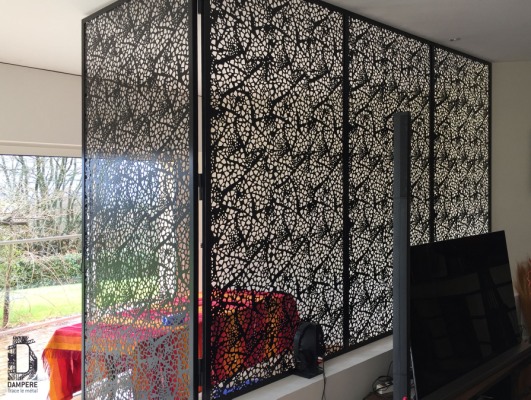
Example of a perforated sheet metal screen Tou Mura an interior partition
